8 in 10 Employees Say They Need AI Training — After Their Companies Already Rolled Out the Tools
Artificial intelligence is reshaping how work gets done, but most employees say they’ve been handed the tools without the training to use them effectively, according to a recent Express Employment Professionals-Harris Poll survey.
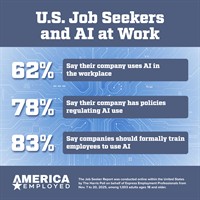
More than 8 in 10 U.S. job seekers (83%) say companies need to formally train employees on how to use AI, rather than expecting them to learn on their own. And hiring managers agree, as 86% say formal AI training should be a company priority.
That urgency reflects just how quickly AI has shifted from optional to expected in the workplace.
Nearly 8 in 10 U.S. companies (79%) now use AI, with more than 2 in 5 (43%) reporting regular use. Just two years ago, only 66% of companies reported using AI, a figure that climbed to 72% in the spring of 2025 and has continued rising since.
Employees feel the acceleration firsthand. Sixty two percent of employed U.S. job seekers say their company uses AI at work, including 22% who say it’s already part of their regular workflow.
The result: AI is everywhere, but training has fallen behind.
The Adoption Curve Is Outrunning Readiness
Among companies using AI, reliance is increasing fast. Eighty nine percent of hiring managers say their company’s dependence on AI tools has significantly increased over the past year, signaling that AI is no longer experimental or optional.
Adoption is especially widespread among:
- White collar companies, where 87% report using AI.
- Large employers, with 91% of companies with more than 500 employees using AI.
At the same time, employees are increasingly open to learning with AI. Seventy six percent of job seekers say it’s appropriate to learn professional skills using AI, including 27% who say it’s completely appropriate.
Rules Without Roadmaps
Seventy eight percent of hiring managers say their company has policies regulating AI use, a view shared by 78% of job seekers whose company uses AI.
But when it comes to actual tools, direction is inconsistent:
- Only 36% of companies provide a list of approved or preferred AI tools.
- 38% allow employees to use any AI tools they’re familiar with.
- 21% report a mix of approved and open use tools.
That lack of clarity leaves many employees navigating powerful technology largely on their own.
The Upside Companies Risk Missing
Despite the training gap, workers remain optimistic about AI’s potential, especially when it comes to building their skills.
Three quarters of job seekers believe AI can be part of the solution, not the problem. Seventy five percent say their company’s AI tools can help bridge skills gaps, and an equal share say they are likely to seek additional training in response to AI advancements. Nearly one third (31%) say they are very likely to do so.
Hiring managers largely back that optimism. Eighty one percent say their company already has the tools needed to train new hires in AI driven workflows, suggesting the obstacle is less about capability and more about follow through.
When asked how companies should prepare future talent as AI expands, hiring managers most often point to hands on, employer led approaches:
- On the job training focused on working alongside AI (44%)
- Dedicated training for skills AI can’t replace (40%)
- Apprenticeship and internship programs that include AI training (38%)
“AI adoption is moving faster than most organizational change ever has,” said Bob Funk Jr., CEO, President and Chairman of Express Employment International. “What this data shows is that companies have focused on getting the technology in place, but not enough on helping people use it effectively. Training is what determines whether AI becomes a source of real productivity or just another tool employees are left to navigate on their own.”
Discover more research and real-world workforce trends from the America Employed series at ExpressPros.com/Newsroom.
Survey Methodology
The Job Insights survey was conducted online within the United States by The Harris Poll on behalf of Express Employment Professionals from Nov. 3 to 19, 2025, among 1,002 U.S. hiring decision-makers.
The Job Seeker Report was conducted online within the United States by The Harris Poll on behalf of Express Employment Professionals from Nov. 7 to 20, 2025, among 1,003 adults ages 18 and older.
For full survey methodologies, please contact Sheena.Hollander@ExpressPros.com, Director of Corporate Communications & PR.
Express Employment Professionals
-
Chris Kaske Manager
- April 22, 2026
- (517) 546-5627
- Send Email
