93% of Job Seekers Say They Are AI-Ready, but 41% of Employers Expect Advanced Skills
Nearly every job seeker believes they are AI-ready, but many may be underestimating what companies now expect, according to a recent Express Employment Professionals-Harris Poll survey.
That confidence is nearly universal, with 93% of job seekers saying they have the AI skills employers want. However, only 35% of job seekers believe companies are looking for advanced or expert AI capabilities, while 41% of hiring managers say candidates need them.
AI proficiency isn’t reserved for highly technical candidates, either. Nine in 10 hiring managers look for at least basic AI skills, and more than half (54%) consider AI proficiency very important or absolutely essential when evaluating applicants.
AI Joins Traditional Hiring Priorities
Even as AI skills become a factor in hiring, job seekers believe employers still place the greatest value on long-standing workplace qualities. When asked which attributes companies consider absolutely essential in applicants, they ranked dependability, work ethic and communication skills ahead of technical and AI capabilities:
- Dependability: 47%, down from 52% in the fall of 2023
- Work ethic: 47%, compared with 48% in the fall of 2024
- Communication skills: 45%, unchanged from the fall of 2024
- Technical skills: 29%, compared with 25% in the fall of 2024
- AI skills: 19%
What Employers Mean by AI-Ready
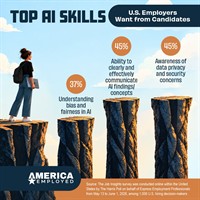
While job seekers may rank traditional qualities higher, hiring managers are looking for specific AI capabilities:
- Awareness of data privacy and security concerns: 45%
- Ability to communicate AI findings or concepts clearly and effectively: 45%
- Understanding bias and fairness in AI: 37%
Job seekers’ assessments of their own abilities, however, vary widely. More than half of millennials (55%) and half of Gen Z job seekers (50%) describe their AI skills as advanced or expert, compared with 31% of Gen X and 12% of baby boomers and seniors. Men are also more likely to anticipate that higher bar, with 42% expecting advanced or expert proficiency compared with 28% of women.
The generational divide is just as clear in what job seekers think employers want. Forty-three percent of Gen Z and millennials believe companies expect advanced or expert AI skills, compared with 25% of Gen X and 10% of baby boomers and seniors. A similar gap emerges between men and women, with 42% of men expecting companies to seek that level of proficiency compared with 28% of women.
“AI proficiency is moving from a nice-to-have to a foundational skill for many jobs,” said Bob Funk Jr., CEO, president and chairman of Express Employment International. “Job seekers who invest in their own development now can gain practical experience and a better understanding of how to use the technology responsibly. Knowing how AI works is only part of the equation. Employees also need to know how to question its output, communicate what it produces and apply it effectively on the job.”
Discover more research and real-world workforce trends from the America Employed series at ExpressPros.com/Newsroom.
Survey Methodology
The Job Seeker Report was conducted online within the United States by The Harris Poll on behalf of Express Employment Professionals from May 19 to June 8, 2026, among 1,000 adults ages 18 and older who are employed but looking for a new job or not employed and looking for work.
Express Employment Professionals
-
Chris Kaske Manager
- September 23, 2026
- (517) 546-5627
- Send Email
