Seasonal Hiring Expected to Rise, With Full-Time Hires in Mind
Seasonal jobs may come with an end date, but new survey findings show companies increasingly see them as the beginning of something longer.
Nearly 2 in 5 U.S. hiring managers (38%) say their company plans to hire more seasonal employees than it did a year ago, and many already have an eye on who might stay. Eighty-seven percent view seasonal roles as a great way to identify future full-time hires, according to a recent Express Employment Professionals-Harris Poll survey.
Seasonal work is already a significant part of the hiring market, with more than two-thirds of hiring managers (67%) saying their company has hired seasonal employees, including one-third (33%) that do so currently. Plans are also trending upward, with 15% intending to add seasonal workers in fall 2026, compared with 12% in fall 2025.
More Than Extra Help During the Rush
Fall and winter holidays are the most common time for companies to hire seasonal employees, cited by 64% of those that have done so. Summer follows closely at 60%.
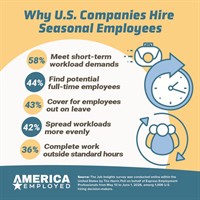
The season may bring workers through the door, but companies are also looking beyond the immediate rush:
- 58% need help meeting short-term workload demands.
- 44% hope to find employees they can hire full-time.
- 43% need coverage for employees who are out on leave.
- 42% want to spread workloads more evenly.
- 36% need work completed outside standard hours.
- 28% cite cost savings.
Seasonal hiring plans are particularly strong in the service industry, where 45% of hiring managers say their company expects to hire more seasonal employees than it did a year ago.
Job Seekers See a Paycheck and a Path Forward
Nearly half of job seekers (45%) have worked a seasonal job, and one-third (33%) plan to do so in the future. Their experience follows a familiar calendar, with fall and winter holiday roles most common at 61%, followed by summer jobs at 53%.
Money may be the main draw, but it’s not the only one. Among job seekers who have worked seasonally, 72% cite financial reasons, including:
- 43% who wanted more money for daily expenses.
- 43% who wanted to add to their savings.
- 25% who wanted help buying gifts.
The value can extend beyond the paycheck, with more than half (54%) citing professional development. That includes 29% who wanted experience for future roles and 27% who hoped to gain new skills. Millennials were especially likely to pursue seasonal work to build their skills at 37%.
“The greatest value of seasonal hiring may be the opportunity to meet today’s workforce demands with an eye on the future,” said Bob Funk Jr., CEO, president and chairman of Express Employment International. “Seasonal employees can help companies manage heavier workloads, cover absences or provide additional coverage, while giving leaders a chance to see how they handle the work and interact with the team before considering them for a permanent position.”
Discover more research and real-world workforce trends from the America Employed series at ExpressPros.com/Newsroom.
Survey Methodology
The Job Seeker Report was conducted online within the United States by The Harris Poll on behalf of Express Employment Professionals from May 19 to June 8, 2026, among 1,000 adults ages 18 and older who are employed but looking for a new job or not employed and looking for work.
The Job Insights survey was conducted online within the United States by The Harris Poll on behalf of Express Employment Professionals from May 13 to June 1, 2026, among 1,006 U.S. hiring decision-makers.
Express Employment Professionals
-
Chris Kaske Manager
- October 28, 2026
- (517) 546-5627
- Send Email